

National STEM Day, celebrated Nov. 8 across the U.S., highlights the creativity and ingenuity needed to succeed in science, technology, engineering and mathematics (STEM) fields.
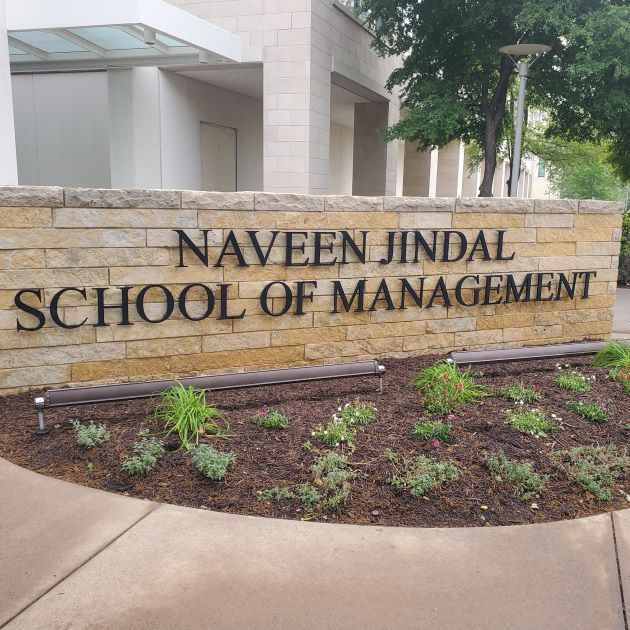
Falling on a weekend this year, it offered the accomplished women at the Naveen Jindal School of Management a moment to pause and reflect on what the day means to them — and how they can continue inspiring others, especially women, to pursue careers in these traditionally male-dominated disciplines.
Faculty Members Exemplify STEM Success

Dr. Dawn Owens, associate dean for undergraduate studies at the Jindal School, said STEM has always fascinated her because it sits at the heart of how humans solve problems, create opportunities and shape the future.
“It’s a space where ideas turn into innovation and where collaboration drives meaningful change,” she said. “At the Jindal School, we recognize that innovation thrives when diverse voices and global perspectives are part of the conversation. As someone passionate about building connections across technology and business, I’ve seen firsthand how collaboration and inclusion drive progress.”

Dr. Monica Brussolo, PhD’11, MS’07, an associate professor of instruction in the Operations and Supply Chain Management Area at the Jindal School, said her passion for teaching and researching STEM fields is driven by a life-long interest in how things function.
“I enjoy exploring processes to understand their interconnections,” she said. “I believe there is always room for improvement and to make any process more efficient.”
Brussolo, assistant dean of the Jindal School’s undergraduate degree programs, is motivated to enhance problem-solving skills in her students, calling it a crucial skill for their professional and personal lives.
“In my experience, there are no disengaged students,” she said. “Instead, it is up to us as educators to find exciting ways to connect with students and ignite their passion for solving complex problems. These opportunities are possible through STEM education.”
Jindal School Students Embrace STEM
At the Jindal School of Management, students are redefining what STEM means for the business world — blending data, technology, and strategic thinking to create solutions with real-world impact.

For SriJananie Nagasubburajan, a graduate student in the MS in Business Analytics and Artificial Intelligence program at the Jindal School, STEM filled a nagging hole in her career.
“I had always felt a gap,” said Nagasubburajan, a student ambassador and president of the Business Analytics Leadership Council at the Jindal School. “I wanted to do more with that data, to uncover insights that could drive smarter business decisions. That’s what led me to pursue Business Analytics and Artificial Intelligence at JSOM.”
The program’s flexibility stood out to her.
“I had the ability to choose different tracks, explore various domains and discover where my strengths truly lie,” she said. “The coursework here doesn’t just teach tools or coding; it’s shaped how I think about data as a bridge between technology and business strategy. It’s changed how I approach problems — I now look for impact, not just precision.”

That same curiosity and problem-solving drive define JSOM’s undergraduates, too. Having grown up with engineers in her home, Audrey Rathgeb, an Accounting senior and a member of the Davidson Management Honors Program at the Jindal School, said she has always been attracted to challenges and that solving difficult problems is just a normal part of life.
“When researching potential schools and majors, the Jindal School drew my attention because of its focus on combining data and research with strategy and real-world application at both the local and global scale. My research on AI in supply chains, leadership roles in student organizations and international study abroad experiences sharpened my technical and critical thinking skills, as well as clarified my long-term goal of obtaining my CPA and contributing to organizations through globally conscious and data-informed decision-making.”
Over this past summer, Rathgeb interned under Lingora Global Marketing at MarketDesigners in Seoul, South Korea, where she had the opportunity to apply her STEM education.
“I was tasked with preparing a Korean language-learning app for entry into the U.S. market,” she said.
Her experience demonstrated how data-driven insights and cultural fluency (core elements of her STEM education at the Jindal School) can drive meaningful global change.
From Classroom to Industry: Alumnae Using STEM to Drive Impact

Barreca Durand, BS’20, is director of global growth for Alkegen, a manufacturer of high-performance thermal and filtration materials. She said the BS in Supply Chain Management and Analytics STEM degree she earned at the Jindal School helped her develop a mindset that is both analytical and strategic, shaping how she approaches complex challenges and makes decisions that add true value.
“I’ve always been drawn to problem-solving and understanding how things work, so pursuing a STEM major at JSOM felt like a natural path,” she said. “What really stood out to me was the balance between technical depth and business acumen. It wasn’t just about formulas and systems, but about how those skills translate to industry impact.”
During one of Durand’s early roles, she led a strategic sourcing initiative that required consolidating global spending across multiple regions. She said her STEM background was very helpful, as it led her to analyze large datasets, identify optimization opportunities and model the financial impact of supplier negotiations.
“The result was a significant reduction in cost and efficiency at the site and improved visibility into our total spend,” she said. “It reinforced how technical and analytical thinking can drive real, measurable business outcomes.”

Those opportunities were not lost on Chavi Singh, MS’25, who graduated in May with an MS in Information Technology and Management. Singh said she was inspired to choose a STEM major at the Jindal School because she wanted a program that blended technology and business, something that would help her move beyond just understanding systems to actually designing and improving them.
The courses, projects and mentorship that the Jindal School provides helped her build confidence in areas like data analytics, Python and product strategy, while also refining her leadership and problem-solving skills.
“During my time at JSOM, I worked on a project that involved analyzing user behavior data to optimize a product’s engagement strategy,” she said. “We had to combine SQL, Python and business analytics to identify key drop-off points. The technical knowledge I gained from my courses helped me clean and analyze the data efficiently, but it was the critical thinking and product management perspective that truly made the difference.”
Advice for Future STEM Students
Durand encourages those women interested in STEM to pursue it because it “opens doors to every part of business, from data science and procurement to business management and strategy. The ability to think critically and solve problems is universal and incredibly powerful. What will set you apart is the ability to approach challenges through diversified problem-solving, strong analytical thinking, and big-picture perspective, all while maintaining depth in technical expertise. It’s just as important to stay curious and open-minded, because you won’t always have the right answers, and that’s okay. You’re there for a reason, and your perspective adds real value to the work and the people around you.”
Rathgeb wants young women who are not sure about whether to pursue a STEM degree and career that their perspective and curiosity are not only welcome but needed.
“Often, the biggest barriers are not external, but rather internal,” she said. “At the Jindal School, there are countless opportunities, programs, staff and resources ready to assist and support you on your STEM journey. Your doubts will be more limiting than anything your STEM path will throw at you. Learn to do hard things and challenge your own assumptions about your limitations. Never be afraid to ask questions. Surround yourself with people who encourage growth and a positive mindset. It’s not about being perfect, having all the answers or being the most technically capable; it’s about being willing to engage and contribute. By overcoming self-imposed barriers, you can not only unlock your potential but also thrive at the Jindal School and help shape the future in STEM through innovative ideas fueled by diverse perspectives.”
Owens said students who are considering which degree to pursue should be aware that the world is increasingly STEM-driven and that the future of business will depend on those who can translate technology into strategy.
“At the Jindal School, our forward-thinking curriculum prepares students to lead and adapt at the intersection of business and STEM,” she said. “We foster an environment where everyone is encouraged to explore boldly, lead confidently and use their ideas to drive meaningful impact.”